Seamless Knit Activewear: What the Machine Actually Does
Run a thumb down the outside of the thigh on a good seamless legging and you are hunting for a seam that is not there: no flatlock ridge, no coverstitch line, nothing to press a crease into the skin two hours into a class. That is not a better seam. It is the absence of one, because the garment was never cut into panels. It came off the machine as a tube.
How a seamless garment is actually made
A seamless garment is knitted on a circular knitting machine: a cylinder of needles, a few hundred at the low end and well over a thousand on the finer gauges, knitting in the round. The tube leaves the machine at roughly the circumference of the finished body, so the width of the garment is set by the cylinder rather than by a pattern piece cut from a roll of fabric.
The shaping is where the skill sits. As the tube grows, the machine holds needles out of work, tucks them, or transfers a stitch from one needle to another. Holding needles out narrows the tube; bringing them back into work widens it. Run that sequence in the right order and the garment nips at the waist, opens at the hip and tapers down the leg — three-dimensional shape knitted into a tube that is otherwise perfectly straight.
Stitch structure changes zone by zone in the same pass. A denser rib where the waistband will sit, open mesh where the body needs to vent, a firmer knit across the seat so it stays opaque under stretch. Because the structure is the pattern, there is nothing to align, no panel to mis-match, and no print to go off-register at the seam.
Here is the part the marketing leaves out: seamless removes the side seam. It does not remove every seam, and a supplier who tells you otherwise has not looked closely at the sample. Waistbands are usually turned and joined, straps are attached, hems are folded and stitched, and the crotch gusset is almost always set in separately. Ask for the seam map before you approve anything.
- The cylinder sets the circumference. Change the size, and you are usually changing the machine or the programme — not the pattern.
- Shape comes from held, tucked and transferred needles. That sequence is the garment's fit, and it lives in the machine's programme.
- Rib, mesh and firm zones are knitted in one pass, so the compression mapping is built in rather than stitched on.
- Straps, hems and the gusset are still joined afterwards. Expect a short second sewing operation on almost every seamless style.
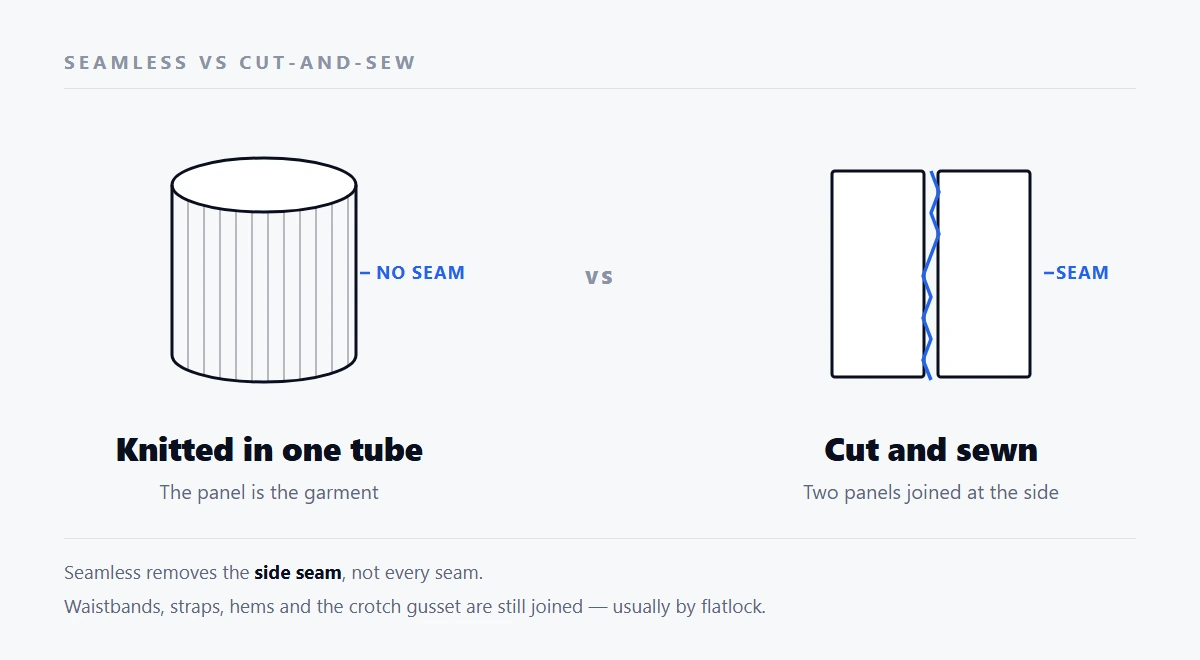
What the missing seam buys you on the body
On a garment worn against skin under load, the side seam is the part that fails first. It is where two panels meet, which means two layers of fabric, a stitch line, and a band of thickness that behaves differently from the knit around it. Removing it changes three things that customers feel even if they cannot name them.
- No friction point. Nothing to rub under a waist belt on a long ride, or against the mat through a hundred sun salutations.
- Shape without darts. The curve is knitted in, so the garment follows the body instead of being cut generously and sewn into an approximation of it.
- Less weight and less bulk. No seam allowance, no overlocked edge to finish, no doubled fabric down the leg.
100% nylon, four-way stretch — so where is the stretch?
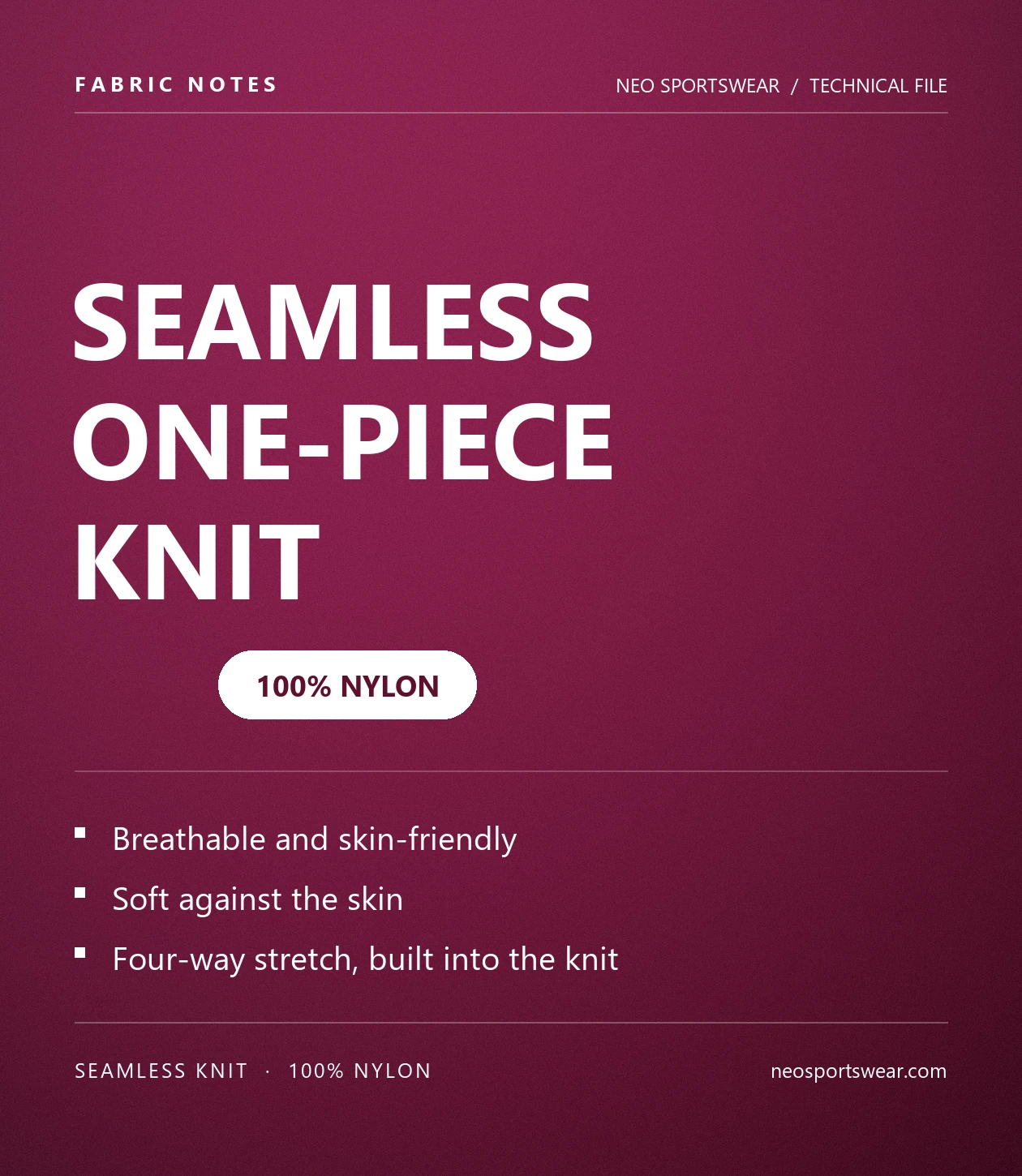
The card in the photograph reads 100% nylon, and the same card claims four-way stretch. Those two statements are not in conflict, and the reason is worth understanding before you sign off a spec sheet.
Nylon on its own is not elastane. What stretches is the knit: every loop is a length of yarn bent into a shape, and under load those loops straighten and slide against one another before the yarn itself has to give. That geometry is what produces structural stretch, and it recovers when the load comes off — not as sharply as elastane, but it recovers. It is also why this fabric reads drier and firmer in the hand than a nylon-spandex jersey, which feels softer and springier because the elastane is doing the work.
- Recovery: elastane wins. If a garment is worn tight and washed hard, spandex holds its shape longer.
- Heat and chlorine: structural stretch wins. Elastane degrades in a hot wash and in pool water; a knit that gets its stretch from loop geometry does not.
- Hand-feel: 100% nylon feels dry, light and slightly firm; nylon-spandex feels softer and more elastic against the skin.
- End of life: a single-material garment can go back into a nylon recycling stream. A nylon-elastane blend mostly cannot, which is why mono-material knits keep appearing in sustainability briefs.
The practical read: for yoga, Pilates, studio and everyday training, a 100% nylon seamless knit is light, dries fast and holds its colour. For compression wear that is pulled on and off daily, or anything heading for a pool, a nylon-spandex knit still earns its place — we cover the difference in more detail in the nylon-spandex guide.
The part buyers underestimate: seamless is not the cheap option
The instinct is that deleting a sewing operation deletes cost. It does not, for the simple reason that the cost was never in the sewing. It sits in machine time, in the minimum run that machine time demands, and in how little you can change once the programme is written.
- The minimum is quoted per colour, per size. A cut-and-sew style can start at 50 pieces because a cutter handles one panel at a time. A seamless programme needs the machine set up for each colour and each size, so mills typically ask for several hundred pieces per colour per size before the run is worth scheduling. Ask for that number specifically, not for a headline MOQ.
- Colour changes cost machine time. Yarn has to be changed and the machine cleared between shades, which is why a five-colour seamless line is not five times one colour — it is often worse.
- Size changes are not pattern changes. A different size usually means a different cylinder diameter or a new programme, so grading stops earlier than it does in cut-and-sew. Getting to a true 3XL on a seamless body is often not possible at all.
- A hole cannot be swapped out. A cut-and-sew leg can have a panel replaced. A seamless body is repaired by hand or rejected, which changes how you plan your AQL and your defect allowance.
- Lead time runs longer. Scheduling machine time, knitting, dyeing and the finishing operation usually adds weeks compared with pulling fabric from stock.
Five questions to put to any seamless supplier
None of these are trick questions. A factory that runs seamless every day answers them without pausing; one that brokers it will go quiet on at least two.
- 1. Which parts are knitted and which are still sewn? Ask for a seam map or a marked-up photo. The answer tells you how much of the garment the machine actually makes.
- 2. What is the minimum per colour, per size? The overall figure is meaningless. The per-colour, per-size figure is the one that decides whether your range is viable.
- 3. How far up the size range can the cylinder go? Find out before you promise a size run, not after the samples arrive.
- 4. Is the yarn package-dyed or is the finished garment dyed? Package dyeing gives tighter lot-to-lot consistency; garment dyeing gives a softer hand, and more shade variation between batches.
- 5. Can you send a size set and a wash test before bulk? Seamless either recovers or it does not, and you only find out after repeated washing. Test it on your own sample, not on a claim.
Where seamless fits in a first order
If your first drop is 50 to 200 pieces per style, seamless is not the right machine yet. The minimums are against you, and a cut-and-sew legging finished with four-needle six-thread flatlock gets you most of the way to the same feel at a fraction of the commitment. This is also the reason seamless rarely appears in the entry-level MOQ conversation: it is an investment in a style you already know sells.
Seamless earns its cost when the product needs to feel different on the shelf, when the fit is the selling point, and when you can commit to a size run and a colour count that the machine can absorb. That is a real product decision, not a sourcing shortcut — and it is worth making deliberately rather than because a sample felt nice.
Tell us which way you are leaning
We run cut-and-sew as standard, and we quote seamless programmes through mills that knit it properly rather than pretending every style is the same machine. If you are weighing the two for a specific style, send the tech sketch and the size run — we will tell you which construction fits your quantity, your budget and your launch date, including when the honest answer is that seamless is not worth it yet.
If you would rather handle a seamless knit before committing to a programme, we keep one in stock: a 160 gsm seamless yoga tee in 100% nylon, 130 g, twenty-six colours, US 4-12. It is the shortest route to feeling the stitch density and seeing where the joins actually fall on a finished garment — and to deciding whether the hand-feel suits your customer before you spend on a custom programme.
Send your spec and we will come back with both routes costed, plus a sample you can pull on.